

Introduction and background
The WAZA Conservation strategy states that a zoo’s mission statement should include a declaration that the institution in question exists for a higher purpose, a pledge that the institution will commit resources to this effort and a plan for cultivating a culture of conservation in staff, communities, and governing bodies. All the work relating to conservation activity should have a measurable difference. With that in mind, this document aims to outline what Tropical World has been doing to contribute to conservation, as well as setting out its goals to improve that contribution to conservation in the future.
Conservation – our achievements (2025 updates)
Wildflower meadows in Roundhay park – Restoring native butterfly habitat
In partnership with Butterfly Conservation, Tropical World has developed two areas of nearby Roundhay park as dedicated wildflower meadows, providing habitat for native butterfly species in the area.
This is a collaborative project which started in earnest in early 2023 and the project has the full support of Roundhay Park’s management structure.
In addition to developing these wild spaces for native butterfly species, Tropical World has set up a survey area (including the newly developed wildflower meadows) following the UK Butterfly Monitoring scheme standard and has been performing pollard walks before submitting the data to the UKBMS. We are now recording data on species richness and abundance allowing us to monitor the impact the project is having on native butterfly numbers within Roundhay Park on an annual basis. The information we gather contributes to the overall analysis of native butterfly populations throughout the UK.
As of 2025 both wildflower meadows in Roundhay park have been further developed and have significantly increased in size:
- Lakeside Meadow is now 2400m2 (increase of 900m2).
- Castle Meadow is now 3600m2 (increase of 1107m2), with this planned to increase annually.
- We continue to source native wildflower seed through contacts in Butterfly Conservation and Natural England.
- Maintenance and land management continues by Greenspaces team, with cutting and removal of vegetation, rotavating, harrowing and reseeding to ensure optimal growth of wildflowers and grasses.
- Future plans include the continued increase size of the castle meadow, though future increases are unlikely to be quite as large as the last couple of years. Maintenance of both meadows is to continue by the greenspaces team, and we are planning to further develop the castle meadow area for other species including amphibians, hedgehogs and invertebrates (see 2025 – forward planning).
It should be noted that the success of this project has had an additional positive effect – Butterfly Conservation have appointed a project co-ordinator to oversee the development of further wildflower meadows in the Leeds area.
EEP participation & Site Development
Tropical World is currently a participant in two European Endangered Species Breeding Programmes (EEP’s) for callitrichids – Pygmy marmosets and Emperor tamarins. Tropical World is a non-EAZA institution currently, so we had to formally apply to join these programmes and pay annual participation fees. We now hold groups of male Pygmy marmosets and female Emperor tamarins. While these are non-breeding, same sex groups, we assist with the overall effort to breed these species in captivity by holding these animals and providing excellent levels of care until they are required by the EEP for breeding purposes. As recently as July 2025, TW sent a pygmy marmoset to Drayton Manor after a request from the EEP co-ordinator to pair up two animals for breeding.
Holding these animals also frees up space and resources for other institutions to breed their animals in line with the EEP’s recommendations. Our long-term goal in holding these animals is to eventually house and care for breeding pairs, hopefully allowing us to contribute more directly to the species’ captive breeding efforts.
Additionally, we still have a group of Elongated tortoises in the collection, including a breeding pair and their offspring. TW has applied to sign up our animals for the EEP which is being set up for the species; we intend to be a fully active participant as we have a proven track record of being able to provide high standards of welfare for the species and can demonstrate strong success in the species’ captive breeding.
We are still able to join an additional 3 EEP’s (as a non-EAZA participant, we can only be actively involved in 5 EEP’s) for threatened species – species of focus include Elongated tortoises (mentioned above), Orange-headed ground thrush and pancake tortoises at present (subject to change with collection plan).
Riverfly Partnership: Kick sampling surveys
Since 2024 Tropical World has been participating in the Riverfly Monitoring initiative, run by the Riverfly partnership. The initiative ensures that angling and conservation groups can take action to conserve river environments by monitoring river quality. This is done by using a standardised methodology to collect materials from sample sites in rivers, with surveyors analysing, identifying, and counting eight invertebrate target groups. The sample sites are monitored on a monthly basis The presence or absence of these pollution-sensitive invertebrates reflect the water quality of the surveyed rivers. The data collected is then entered into the national riverfly database and once verified, are freely and publicly available. If results collected by the TW team show a decline in water quality in any of the survey sites, then it is flagged by the Ecology contact at the Riverfly Initiative and quick action can be taken to identify the potential source of pollution and deal with it.
As of 2025, we now have 5 members of the TW team who have been trained as certified Riverfly surveyors. We continue to monitor three sample sites – Wyke Beck, Horsforth Beck and Meanwood Beck. The results from these surveys have been uploaded to the Riverfly Initiative Cartographer site with no site yet scoring low enough to ‘trigger’ a retest and possible further investigative action. The intention is to train even more additional TW staff members to be Riverfly surveyors so they can participate in the conservation effort of our local rivers as well.
Bumblebee Conservation surveys
In 2025 Tropical World completed a season of data collection to participate in the Bumblebee Conservation Trust’s BeeWalk Survey Scheme. This involves staff at Tropical World walking a transect (similar to the UKBMS) on this fixed route once a month to monitor the abundance of bumblebees. The transect route starts in Roundhay park at the castle folly, going up through the lakeside meadow, up to Canal gardens. This data is then uploaded to the BeeWalk scheme website and helps the Bumblebee Conservation Trust monitor changes in bumblebee populations, detect any warning signs of decline as well as direct future conservation activities. The intention is to train 2-3 additional members of staff initially as BeeWalkers to assist in data collection for this project.
iNaturalist – Tropical World and Roundhay park updates
Tropical World staff continue to record and upload data using the iNaturalist app in 2025, recording 86 observations of 47 native species in the area surrounding Tropical World and Roundhay Park, and beyond, as of early September. These recorded observations of native species create research-quality data for scientists working to better understand and protect nature. The data collected by Tropical World is available to be used by researchers via the iNaturalist website.
In line with BIAZA’s Spotted on Site Bioblitz campaigns, we also encourage our visitors and members of the public via social media to download the app and start recording native species so they too can contribute to conservation through citizen science data collection. TW joins other zoos in the SoS Bioblitz campaigns, with our scores during the campaign compared against other participating zoos in a “league table”.
Signage
Animal enclosure signage has been revamped and updated across site, and a specific area at the entrance of the zoo has been designated as the “conservation wall” where conservation-specific interpretation is displayed. This informs visitors of the Tropical World’s conservation work from TW-led projects to our involvement in captive breeding, to donations to overseas partners working with species in-situ. Going forward there are plans in place to modify the existing wildflower meadow signage, replacing the three current signs with just one which gives a more concise explanation of the project. This will free up wall space for signage related to our other conservation work.
Signage to be developed and installed in the near future include: general conservation signage (‘what is conservation?’), EEP’s, Riverfly Kicksampling and BeeWalks.
Fundraising: Financial contribution to the Angkor Centre for Conservation of Biodiversity (ACCB) and Proyecto Titi
Proyecto titi – In 2024 we were able to support the cotton-top tamarin project by donating £500, through collected donations from Tropical World visitors. This money is used to “support our education and awareness programs that teach communities that cotton-top tamarins are not pets, since that is one of the main threats to the species. We have school programs for teenagers, traveling puppet shows for smaller kids and wider audiences, and adult education programs with local farmers and artisans. That would help us cover staff, materials, and transportation to all the places we take our programs every week.”
Additionally, it has been decided that 10% of all funds raised via meerkat adoptions will be donated to Proyecto titi each year.
ACCB:
The £500 donation sent in 2023 “provided supported the Elongated Tortoise reintroduction project by covering the supplemental food provided to the tortoises while in the acclimation pen, this has been crucial for them adjusting to their new environment. Furthermore, the funds covered travel costs to the release site to be able to conduct field work, and finally it contributed to the procurement of some supplies”. See below for a breakdown of how donation money was spent as per Christel Griffioen. In 2025 we donated another £500 to the elongated tortoise project, using money collected through donations via Tropical World visitors. The current plan is to donate £500 annually to support the ACCB’s work with elongated tortoises in Cambodia.
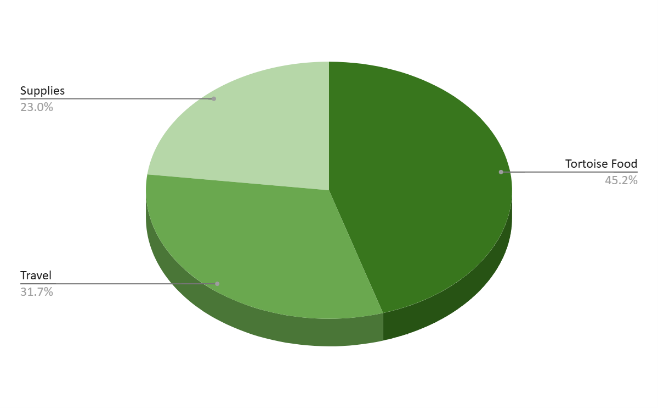
Update from Christel Giffioen regarding the 2025 donation: This year's funds will cover travel cost and field equipment procurement and repairs related to the post-release monitoring of the elongated tortoises released in 2024. We are planning the release of a second cohort in 2026, for this we are still securing funding. Funding would be used for the transport of the tortoises, supplement feeding, salary for tortoise guardians during the acclimation period, trackers to allow post-release monitoring, and travel cost for our team to the release site.
Sustainable products
The Tropical World café continues to use paper bags and has introduced paper-based takeaway containers for food and drink. Efforts continue to replace existing for-sale items with more sustainable alternatives – for example, the café currently stocks ‘Wild Waters’ soft drinks which supports the BIAZA Rainforest Conservation Initiative with each bottle sold.
The Tropical World Gift Shop still uses paper bags for the sale of gifts, toys, and other goods in place of plastic bags. The shop sells bamboo-based products such as personalised cups and dishes and also eco-friendly soft toys and other gifts. A regular dialogue is being maintained with all the retail suppliers on reduction and alternative material sourcing for products in the shops.
The giftshop also now advertises examples of the products available on the Proyecto titi website which when sold will financially support the Proyecto titi Cotton-top tamarin conservation effort, further highlighting that Tropical World’s link to that project and therefore contributing to the conservation of the species in the wild.
As more products come online, we will ensure we inform our visitors through interpretation, signage, and social media that the food/products they are purchasing are from ethical sources, we will undertake awareness raising about the difference this makes to wildlife worldwide and what visitors can do to support this.
Education
Tropical World’s education team also contributes to its conservation output through formal school workshops. In addition to meeting National Curriculum objectives, the workshops relate to real-world conservation issues and what the children can do themselves at home and school to reduce their carbon footprint, recycle their waste goods and protect the environment in which endangered animals live. The launch of a new Butterfly Scientist workshop also provides the opportunity for the education team to promote the conservation work taking place in the wildflower meadows, with the children using spotter sheets and keys to identify the butterfly species themselves. See the TW Education Policy and specific detailed workshop plans for more information.
Additionally, the Tropical World animal keeping team offer advertised animal talks during school holidays, focusing on a wide range of taxa. The main information included in these talks refers to the natural history of these species, as well as specific information about the individual animals at Tropical World. The keeper talks also contain conservation messaging informing the visitors what they can do at home to protect the natural world.
2025 – Forward planning
Pond development and amphibian monitoring
The next project we are excited to develop is to plan and deliver an amphibian-friendly pond in Roundhay Park, ideally very close to the castle folly wildflower meadow. In addition to delivering this project, we intend to develop the amphibian survey skills of TW staff so that the newly developed pond can be monitored so we can collect baseline data on amphibian populations in that area of Roundhay Park. As with the wildflower meadows, TW staff and greenspaces colleagues would continually maintain this pond and monitor population numbers in an effort to provide habitat for amphibians in the area.
With the development of the castle folly area, we can potentially apply to have the area officially designated as a ‘local nature reserve’ (LNR), offering statutory protection for the species that live in the reserve. Other benefits include increasing public awareness and enjoyment of nature, providing additional greenspaces with many benefits for both people and wildlife.
Common Lizard Project
Working alongside LCC partners we are proposing to begin monitoring several distinct (but struggling) populations of Common Lizard (Zootoca vivipara) in Leeds. The first step involves putting ‘Artificial Cover Objects’ (ACO’s) in-situ in the lizard’s habitat and letting them bed in over winter. Then around April time we intend to survey all three habitats with the intention of finding out how stable and healthy the three populations are. We will also assess the habitat and will look at restoring it to ensure it is optimal for the species’ survival.
If it is found the lizards are struggling due to factors such as habitat degradation, human encroachment on habitat, pollution etc. then we could potentially discuss whether it would be viable to take a group of animals from the wild to captive breed ex-situ, with a view to reintroducing offspring to the wild either in the restored/protected areas or new areas in Leeds if suitable habitat can be identified. This is potentially a long-term conservation project which includes habitat restoration/protection and captive breeding, and as such is to be a primary focus in terms of conservation work over the next 12 months.
Hedgehog homes in Roundhay Park, and the National Hedgehog Monitoring Programme
We are interested in developing “hedgehog homes” in Roundhay Park (possibly again in and around the wildflower meadows) to provide shelter for hedgehogs in the area. In addition to this, we could survey these hedgehog homes utilising camera traps, to record and monitor hedgehogs (and other species) in the area. Hedgehogs are currently classified as ‘vulnerable’ in the UK and are a protected species.
The National Hedgehog Monitoring Programme (NHMP) is a “new pilot project, that will, for the first time, produce robust hedgehog population estimates. Where previous large-scale surveys give us information on where hedgehogs are, this new survey will tell us how many there are. Surveys that indicate only where hedgehogs are present, don’t reveal how that population is faring until it has disappeared, but monitoring numbers can give us warning if the population is in trouble. We’ll also look at regional and habitat differences in hedgehog populations, to identify what factors impact them. With this knowledge, we will make effective conservation plans, so that we can reverse the decline of this iconic species.”.
Tropical World staff have signed up as volunteers to look through collected camera trap images to classify hedgehogs (and other non-hedgehog species) seen in the images (via a website called mammalweb). We are assisting ad getting involved with the project this way in the first instance, while looking at becoming more actively involved by building the hedgehog homes and installing camera traps ourselves.
Local programme of protection
Tropical World are looking to install “Bug hotels’’ that can provide shelter for a native species from insects to small mammals potentially. These bug hotels will be monitored for activity allowing us to document which native species we have in the area, and if we do this consistently year by year, we can build a database of species and their numbers allowing us to monitor populations annually. The bug hotels would primarily be used as a teaching tool, giving staff a fantastic opportunity to develop their survey skills as well as train young conservationists in basic conservations skills, such as building the bug hotels and monitoring species numbers/populations levels. Specific locations for these bug hotels are still to be determined but could potentially be included around the wildflower meadows and possible future LNR.
Further development of wildflower meadows
As mentioned above, Tropical World intends to continually develop our wildflower meadows for the foreseeable future, providing further habitat for native butterfly species and invertebrates. We continue to collaborate closely with our colleagues in the greenspaces department to discuss logistics and timeframes of potential seeding, with the intention being to develop the meadows annually.
Fundraising: Further donations and support to the ACCB and Proyecto Titi
Continued support of ongoing projects via donations sourced from TW visitors.
Recycling
While Tropical World does recycle its waste, our intention is to roll this out across all aspects of the zoo giving us the opportunity to provide educational information on why recycling is absolutely critical in modern times, and its benefits to the natural world as the visitors dispose of their rubbish while on site.